
 Back
Back









Table of Contents

Government-backed investment programs have become a vital resource for startups seeking financial support without sacrificing equity. These initiatives, ranging from grants for startups to tax incentives, offer entrepreneurs access to non-dilutive capital that can fuel growth and innovation. With 5.5 million new business applications filed in 2023, the demand for accessible funding solutions has never been higher.
This analysis of types of investors in startups positions government-backed programs within a broader spectrum of funding, linking state investments to other investor profiles. Throughout this article, we’ll explore diverse funding options, including grants, loans, tax benefits, and contract assistance, while providing actionable strategies to secure these resources.
Let’s jump right in!
How Government-Backed Investment Programs Can Help Your Startup Grow
Government-backed investment programs offer non-dilutive funding, helping startups access capital without sacrificing ownership.
Recent data confirms the scale of these programs. For example, non-dilutive funding programs offer up to $305,000 for prototype or proof-of-concept development within six to 18 months. Funding is non-dilutive, targeting early technical milestones. This helps startups accelerate R&D without giving up equity.
Government programs are particularly appealing because they allow founders to retain control while accessing essential resources to scale their businesses.
Why Non-Dilutive Funding Matters
Unlike private equity or venture capital, non-dilutive funding mechanisms ensure that founders maintain their ownership percentages. This is crucial for startups aiming to preserve long-term value and decision-making power. Programs such as grants for startups provide capital that doesn’t require repayment, while tax incentives and low-interest loans offer additional financial relief.
Emerging trends also point to the increasing digitalization of grant applications, which streamlines the process for startups seeking faster approvals. This shift not only reduces administrative burdens but also accelerates access to funding, enabling businesses to focus on growth.
Real-World Examples
Several startups have successfully utilized government funding to scale their operations. For instance, OpenGov's Government Cloud Platform expanded its reach to over 1,000 agencies by tapping into government-focused solutions. Similarly, Distributive's Public Sector Cloud Adoption showcases how innovative models can save costs while driving growth. These examples underscore the transformative impact of non-dilutive funding on startup success.
As the demand for non-dilutive capital grows, startups are increasingly turning to government programs to fuel their ambitions. Whether through grants, tax breaks, or loans, these funding options provide a pathway to sustainable growth without compromising equity.
Startups like yours already closed their rounds with us.
Founders across every stage and industry. Here's what it took.
- Raised $7.6M for Swiipr Technologies
- Raised $0.5M for Ap Tack
- Raised €0.5M for Ivent Pro

Choose the Best Government Funding: SBA Loans, Grants, and Tax Benefits
Securing government funding can be a game-changer for startups and small businesses. Whether you're looking for non-dilutive capital, disaster relief, or support for research and development, understanding the nuances of SBA loans, grants, and tax benefits is essential. This section explores these funding avenues, helping you identify the best fit for your business needs.
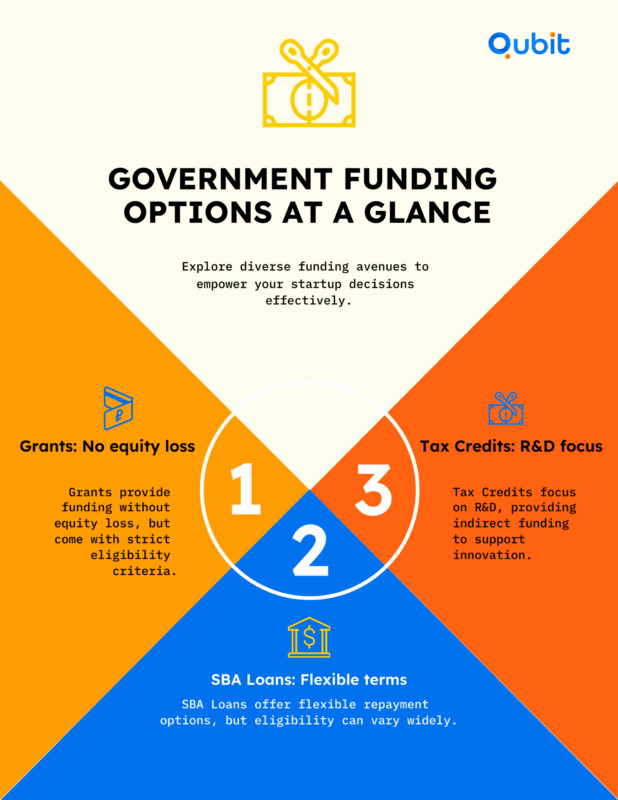
1. Grants: Non-Dilutive Capital with Stringent Requirements
Grants are an attractive option for startups seeking non-dilutive capital, meaning you won’t have to give up equity in your business. However, they come with rigorous eligibility criteria and reporting obligations. Federal grants often focus on specific industries, such as healthcare, technology, or education. They require detailed proposals outlining your project’s goals and impact.
To illustrate, some government grant programs provide up to S$250,000 for Proof-of-Concept stages and S$500,000 for Proof-of-Value validations. These staged grants ensure rigorous selection while providing meaningful runway for startups. Understanding grant size can guide founders’ planning and application targeting.
2. SBA Loan Programs: Tailored Financial Solutions
The U.S. Small Business Administration (SBA) offers a variety of loan programs designed to meet diverse business needs. These loans provide flexible terms and competitive interest rates, making them a popular choice for startups and small businesses.
- 7(a) Loan: Ideal for working capital, equipment purchases, or real estate projects. Learn more about this versatile funding option on the 7(a) Loan page.
- 504 Loan: Perfect for large-scale expansions or acquiring major fixed assets. Details are available on the 504 Loan page.
- Microloans: Designed for early-stage businesses, these loans can cover inventory, initial staffing, or other startup costs. Visit the microloan page for more information.
- EIDL (Economic Injury Disaster Loans): Specifically for businesses impacted by declared disasters, these loans offer critical relief. Learn more about EIDL on the EIDL page.
Each SBA loan program has unique eligibility requirements. Review the specifics of each program to find the best fit for your business goals.
3. R&D Tax Credits: Fueling Innovation
Research-focused startups can benefit significantly from R&D Tax Credits, which reduce corporate tax liabilities and free up capital for growth. These credits reward businesses investing in innovation, whether through product development, software creation, or process improvement.
4. SBIR and STTR Programs: Phased Support for Research
The scale of innovation support is substantial. The SBIR and STTR programs have awarded over $70 billion in R&D funding to small businesses and startups, with more than $4 billion allocated each year. This investment ensures consistent resources for qualifying R&D applicants.
For startups focused on high-impact innovations, the Small Business Innovation Research (SBIR) and Small Business Technology Transfer (STTR) programs offer phased funding to support research and commercialization.
- SBIR: Provides multi-phase support for product development, from concept to commercialization. Explore opportunities on the SBIR page.
- STTR: Encourages collaboration between startups and academic institutions, fostering groundbreaking advancements. Learn more on the STTR page.
These programs are highly competitive but offer substantial resources for businesses driving technological progress.
Combining Federal and State Programs for Maximum Impact
Building on these funding options, founders can enhance their capital strategy by combining federal and state programs. This approach enables startups to access a wider range of grants, loans, and incentives tailored to their business stage and location. By layering support, founders may cover more expenses, meet matching requirements, or unlock additional resources. Coordinating applications across programs requires careful planning but can significantly increase overall funding and support.
1. Compliance and Legal Considerations
When pursuing government funding, it’s vital to ensure compliance with regulatory frameworks. Examining how startups navigate legal complexities when receiving sovereign wealth fund investments can shed light on the level of legal preparedness needed for similar forms of state-backed support. Understanding these nuances can help you avoid pitfalls and maximize the benefits of government funding.
2. Matching Funding Choices to Your Startup Profile
These government programs are most effective when selected based on your startup’s sector, stage, and eligibility criteria. For example, technology and research-driven companies may benefit from R&D grants, while manufacturers might prioritize export or equipment loans. Carefully reviewing program guidelines ensures a strong fit and increases the likelihood of approval. Tailoring your approach to your business profile maximizes both funding and strategic value.
3. Community and Regional Grants
Community and regional grants focus on fostering local economic development through performance-based metrics. Programs like the Community Development Financial Institution (CDFI) Fund provide localized support for underserved markets, enabling communities to access capital for growth and revitalization. For example, the CDFI Fund empowers organizations to deliver financial services in areas that need them most, ensuring sustainable development.
State-level initiatives, such as the Texas Enterprise Fund (TEF), offer incentives for businesses looking to relocate or expand within Texas. The TEF Fund exemplifies how states can attract investment while boosting job creation and regional competitiveness.
4. Research and Innovation Grants
Research and innovation grants are pivotal for startups aiming to break into emerging markets. Programs like the New Markets Tax Credit (NMTC) encourage private investment in underserved communities, creating opportunities for startups to collaborate with investors on transformative projects. The NMTC Program is a prime example of how government funding can spur innovation while addressing community needs.
These grants often prioritize projects that demonstrate scalability and long-term impact, making them ideal for startups with groundbreaking ideas.
Programs are available for every stage of growth. For instance, the IP Strategy Development Program offers up to $50,000 for intellectual property planning and asset development. These targeted grants stimulate local ecosystem innovation.
5. Contract Assistance Programs
Equity in federal contracting is a key focus of contract assistance programs. These initiatives aim to help underrepresented groups, such as minority-owned businesses, access lucrative federal contracts. By breaking down barriers to entry, these programs contribute to a more inclusive economy while enabling businesses to scale through government partnerships.
startups funded by sovereign wealth funds offer a compelling parallel, these ventures often benefit from structured support and strategic capital from state-affiliated sources. Similarly, contract assistance programs can serve as a launchpad for businesses seeking to grow through public sector collaboration, showcasing the power of government-backed opportunities in fostering innovation and economic equity.
Your Guide to Winning Startup Funding Applications
Securing funding for startups requires more than just a compelling idea, it demands a strategic approach to application processes. Success begins with detailed research into funding programs and their specific requirements. By understanding the nuances of each program, startups can tailor their applications to align with the expectations of funding bodies.
1. Prioritize Financial Projections
Accurate and comprehensive financial projections are essential. Investors and funding agencies want to see clear evidence of profitability and sustainability. Break down your revenue streams, operational costs, and growth forecasts in a way that demonstrates both realism and ambition. This step not only builds trust but also showcases your startup’s preparedness for scaling.
2. Follow Phased Program Guidelines
Programs like the Small Business Innovation Research (SBIR) initiative often require a phased approach. This structure helps mitigate risks while ensuring compliance with program guidelines. Startups should focus on meeting each phase’s requirements meticulously, as this increases the likelihood of advancing to subsequent stages and securing additional funding.
3. Utilize Tools for SBA Loan Connections
Finding the right funding partner can be challenging, but tools like Lender Match simplify the process. Suggesting Lender Match to quickly identify potential SBA lenders based on your startup’s profile can save time and connect you with suitable financial institutions.
Using Digital Platforms to Simplify Funding Applications
- Start by searching central portals like Grants.gov to identify current federal grant and contract opportunities relevant to your business.
- Use SBA’s Lender Match and SBIC directories to connect with approved lenders and investors offering tailored loan and equity products.
- Subscribe to official newsletters and alerts from state agencies to stay updated on new or reopening programs that match your eligibility.
4. Understand Government Funding Trade-offs
While government funding can be advantageous, it’s important to weigh the pros and cons of sovereign investments. A review of these trade-offs provides insight into the benefits and potential drawbacks of accepting capital from government sources.
By combining thorough research, precise financial planning, and strategic use of tools, startups can position themselves as strong candidates for funding opportunities.
- Research programs
- Prepare financials
- Follow guidelines
- Use connection tools
- Evaluate trade-offs
Make the Most of Government Grants and Contract Support
Government-backed investment programs for startups provide opportunities to drive innovation, community growth, and economic development.
A compelling example comes from Texas. The TSBCI program received $472 million in government-backed funds to support small business growth across the state. This large allocation expands ecosystem capacity, enabling regions to tailor capital access for innovation and job growth.
From federal grants to state-level incentives, these programs are designed to support diverse needs, including regional development, research initiatives, and equitable access to contracts. Understanding the scope and eligibility criteria of these programs can help businesses unlock their full potential.
Conclusion
Government-backed programs can be the cleanest way to fund growth without handing out slices of your cap table. Grants, SBA loans, tax credits, R&D programs, and contract support each solve different problems, from prototype milestones to expansion capital. The winners are rarely the “best startups.” They are the best-prepared applicants. That means matching the right program to your stage, tightening your financial projections, and following guidelines like your runway depends on it.
It also means tracking deadlines and using official portals, not random blog lists. For a sharper funding plan and stronger applications, use Qubit Capital’s startup fundraising consulting services, powered by our AI startup fundraising platform.
Key Takeaways
- Government funding is non-dilutive, so you keep equity while accessing capital for growth, R&D, hiring, and market entry.
- The funding demand is massive, with 5.5 million new business applications filed in 2023.
- Some non-dilutive programs offer up to $305,000 for prototype or proof-of-concept milestones within six to 18 months.
- Staged grants can reach S$250,000 for proof-of-concept and S$500,000 for proof-of-value, with strict reporting requirements.
- SBIR and STTR have awarded over $70 billion total, with more than $4 billion deployed each year for R&D.
- Stack federal and state programs to widen coverage, meet matching rules, and unlock extras like IP support up to $50,000.
- Use official tools like Grants.gov and SBA Lender Match to find credible programs and reduce wasted application cycles.
Get your round closed. Not just pitched.
A structured fundraising process matched to your stage and investor fit.
- Fundraising narrative and structure that holds up
- Support from strategy through investor conversations
- Built around your stage, model, and timeline
Frequently asked Questions
How do I apply for government funding for startups?
Applying for government funding for startups involves researching eligible programs, preparing financial projections, and meeting compliance requirements. Tailor your application for the best chance of success.