

 Back
Back










Table of Contents

Pitch decks offer a direct path to sparking investor interest, yet small oversights can derail even the most promising business ideas. The stakes couldn’t be clearer, just 1% of investor deck presentations actually lead to new funding. This stat underscores how crucial it is to avoid even minor errors when pitching.
This guide presents straightforward tips for crafting a story that resonates, so you can steer clear of missteps that often undermine funding efforts. By refining each element for clarity and impact, you’ll be ready to confidently present a pitch that stands out and propels your funding journey.
Tailoring Your Pitch Deck for Investor Fit
Building on this foundation, tailoring your pitch deck to each investor’s profile can significantly boost engagement. Different funding stages and investor types prioritize distinct criteria, so adapting your content increases alignment. This approach ensures your message resonates, whether you are targeting angel investors, venture capitalists, or strategic partners. By customizing your deck, you demonstrate professionalism and a deep understanding of investor expectations.
Before diving into design, let's start with a solid understanding of what a pitch deck is and why each slide plays a specific role in shaping investor perception.
Startups like yours already closed their rounds with us.
Founders across every stage and industry. Here's what it took.
- Raised $7.6M for Swiipr Technologies
- Raised $0.5M for Ap Tack
- Raised €0.5M for Ivent Pro

10 Common Pitch Deck Mistakes To Avoid While Creation
Investors can quickly disengage when faced with lengthy pitch decks packed with dense text. To avoid this, look at the common mistakes in pitch deck which a human eye can oversight and create streamlined approach works wonders.
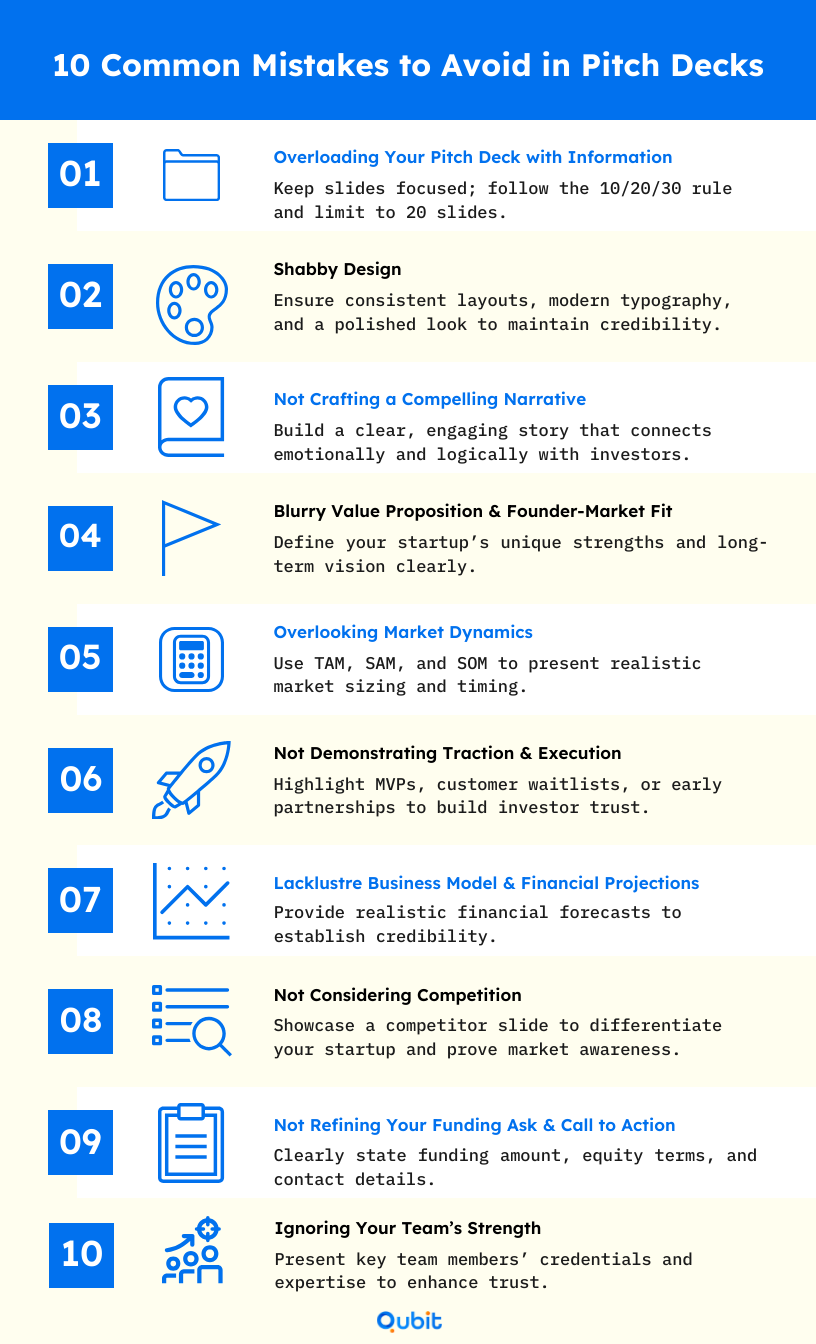
Mistake 1: Overloading with Information
Current best practices favor brevity, an effective pitch deck may contain just 10 pages focused on the core business problem, solution, market, unique edge, and projections. Take inspiration from Guy Kawasaki’s ten slide pitch deck concept. The '10/20/30 rule' recommends 10 slides, presenting in 20 minutes, using 30-point font.
Instead of overwhelming your audience, opt for a problem-solution pitch deck that focuses on essential points and eliminates unnecessary clutter. This deliberate strategy fosters clarity, allowing your value proposition to shine.
Stick to a slides limit of 20 slides, ensuring that each one serves a purpose. When your pitch deck is easy to follow, you instill confidence and make a lasting impression.
A proven framework is Peter Thiel’s 10/20/30 rule: maximum of 10 slides, 20-minute presentation, and minimum 30-point font. Adhering to this ensures clarity and professionalism.or added structure, consider pitch deck critical slides which provides a solid foundation for crafting your narrative.
Mistake 2: Shabby Design
A polished, professional design can transform your pitch deck timeline into a compelling story that leaves a lasting impression. Misaligned layouts, mismatched fonts, or dreary color schemes often pull focus away from your message, diminishing its impact. Considering that investors typically review around ten pitch decks each day, your slides need to stand out amidst this daily influx. For a fundraising pitch deck, consistency is key, uniform layouts, modern typography, and harmonious color palettes bring clarity and sophistication to your presentation.
Following Pitch Deck design principles ensures your slides remain clean and engaging, avoiding clutter that might dilute your message. A strong design strategy doesn’t just support the pitch deck timeline; it underscores your innovative thinking, making your ideas more captivating to potential investors.
Mistake 3: Not Crafting a Compelling Narrative
One of the most common pitch deck mistakes is failing to craft a compelling narrative that hooks investors from the start.
Consider the Waveup Story: initially, their client’s pitch deck struggled due to a fragmented narrative. After refining their story, they secured funding within a matter of months. This example highlights how an engaging narrative can uplift not just the pitch deck market slide but also improve the traction of pitch deck feedback during investor discussions. A unified story, therefore, becomes the cornerstone of a winning pitch.
Mistake 4: Value Proposition & Founder-Market Fit
A well-crafted pitch deck problem slide serves as a cornerstone for defining and spotlighting your startup's unique value.
Take CrewApp, for instance, with its tagline, “The most trusted collaborative workspace in the world.” This statement isn't just aspirational; it reflects a focused, long-term vision that inspires confidence. Similarly, a strong value proposition in the Pitch Deck conveys the unique strengths that make your startup irresistible to investors.
Encore’s seed deck is another great example. By clearly articulating its vision and value, the company successfully raised $3M in funding. It’s a testament to how clarity and focus in your narrative can resonate deeply with investors.
Crafting a story that highlights why your team is uniquely positioned to succeed not only shows your expertise but also underscores your startup's potential. When you communicate these insights effectively, you can transform initial skepticism into genuine trust. By refining your value proposition and showcasing founder-market fit, you’re not just pitching—you’re building a bridge of confidence.
Mistake 5: Overlooking Market Dynamics
Overlooking market dynamics is among the common pitch deck mistakes that can undermine investor confidence.
Precise market estimates serve as a cornerstone of reassurance for stakeholders, reinforcing the financial and strategic integrity of your pitch. TAM stands for Total Addressable Market, SAM is Serviceable Available Market, and SOM is Serviceable Obtainable Market. Validated data doesn't just support forecasting, it acts as a credibility booster, ensuring your top pitch decks stand out in competitive investment scenarios. After all, numbers tell a story, but how you frame that story makes all the difference.
Take Minut as an example, it showcases clear and concise market communication alongside a $15M valuation. Similarly, Boxedup presents a rational and compelling approach that has fueled its early-stage achievements.
Using concrete figures and detailed metrics is not just a best practice; it's a necessity to maintain credibility. Investors are quick to spot inconsistencies, and nothing undermines a pitch faster than shaky estimations.
This is where tailoring your presentation to meet specific investor needs comes into play. By tailoring your pitch deck to resonate with your audience, you avoid the trap of delivering a generic presentation that fails to engage or inspire.
Mistake 6: Not Demonstrating Traction & Execution
Early signs of progress are crucial to proving the viability of your startup concept. Showcasing initial momentum through MVPs, customer waitlists, or early partnerships helps establish trust with investors and illustrates your ability to execute plans effectively.
When you highlight concrete milestones, it signals that your startup is not just moving forward, but doing so with measurable outcomes. Investors value these demonstrations because even modest accomplishments help mitigate risk and showcase your team's reliability in delivering on commitments.
Incorporating data-driven evidence, such as growth metrics or feedback from beta tests, strengthens your narrative even further. These details make your vision more tangible and provide a clearer picture of your direction. For additional guidance, dive into advanced pitch deck strategies, where you'll find expert tips to refine your narrative and improve how you present your pitch.
Mistake 7: Lacklustre Business Model & Financial Projections
A strong business model paired with clear financial projections lays the groundwork for earning investor confidence. On the flip side, vague plans or overly ambitious forecasts can erode credibility, particularly if they fail to demonstrate a thoughtful allocation of capital for sustainable growth. Leveraging detailed guidance from a financial model offers a reliable framework for crafting accurate projections. For example, projecting $5 million in revenue over five years may resonate as achievable, whereas aiming for $500 million in just three years might raise eyebrows.
Transparent forecasts and well-structured strategies are the backbone of investor trust. Equally critical is mastering presentation skills, ensuring your audience fully grasps how their capital will be utilized. When investors clearly see the path to success, their confidence grows, paving the way for long-term collaboration.
Mistake 8: Not Considering Competition
Understanding your market rivals provides crucial insights for pinpointing your startup’s strengths. A thoughtfully crafted competitor slide can set your business apart, emphasizing its unique qualities. Skipping this step might leave investors questioning whether you have a solid grasp of your market.
Consider the Simba Chain as an example. Their Series A pitch deck highlights how a clear, concise presentation can effectively position a company, ultimately contributing to a $25M valuation.
Incorporating compelling visuals and storytelling techniques for pitch decks elevates your pitch, making it memorable and impactful. This approach delivers clear, data-driven insights that reassure stakeholders of your profound market expertise.
Mistake 9: Not Refining Your Funding Ask & Call to Action
A clear and well-defined funding request eliminates uncertainty and keeps potential investors focused.
For context, a recent seed round reached €105M. Presenting a confident, specific ask can open doors to significant capital. By outlining the exact amount needed, equity terms, and contact information, you minimize the risk of missed opportunities.
When you include precise funding details, it reflects professionalism, inspires confidence, and encourages investors to engage. Be explicit about the numbers, equity splits, and how to reach you.
This transparency not only builds trust but also transforms interest into actionable investments. By adopting these targeted strategies, you create a solid foundation for future conversations with investors, setting the stage for meaningful growth opportunities.
Mistake 10: Ignoring Your Team’s Strength
Investors pay close attention to the team slide, dedicating over 15% of their review time to analyzing key member profiles. Presenting comprehensive credentials and complementary skills not only enhances credibility but also fosters trust.
One standout case involved a client whose redesigned slide, celebrated as a Superhero Team Slide Success, became a pivotal factor in securing a Series A round and driving further expansion. By offering a well-structured overview of each team member’s expertise, you can effectively communicate relevant experiences that inspire confidence.
Take the opportunity to spotlight your team’s varied achievements, innovative strategies, and steadfast dedication. A thoughtfully constructed slide speaks volumes, encouraging investors to take that all-important next step.
Additional Common Pitfalls
Making your pitch deck shine requires steering clear of several common missteps. Including extraneous details, such as irrelevant product features or targeting the wrong investors, can water down your core message. Instead, zero in on the information that speaks directly to your ideal audience. Take a lesson from history: The infamous Fyre Festival pitch deck serves as a cautionary tale. Its flashy visuals and inflated claims lured investors but failed to address fundamental elements. Keep your slides focused, overloading them with unnecessary details only detracts from their power.
If your business operates in a regulated sector or international market, tailor slides to address specific investor concerns.
Keep Your Pitch Deck Updated
Building on these lessons, regularly updating your pitch deck ensures it accurately reflects your startup’s latest progress and milestones. Outdated information can erode investor trust and signal a lack of attention to detail. By revising your deck to showcase new achievements or strategic pivots, you present a dynamic, credible business. This ongoing process helps maintain relevance and increases your chances of securing funding.
Conclusion
Avoiding common pitch deck mistakes is essential for creating a concise and engaging presentation that attracts investors. Throughout our discussion, we explored effective strategies that combine compelling storytelling with clear financial insights. By addressing common hurdles, you can project a polished image without overwhelming your audience.
By weaving these elements together, you’ll be able to deliver presentations that not only capture attention but also inspire confidence among investors. For startup founders, adopting this approach simplifies the communication of critical information while showcasing preparedness and credibility. Balancing narrative with financial data ensures your message is both compelling and straightforward.
We at Qubit Capital can help you craft a compelling pitch deck that resonates with investors. Remember, a well-designed pitch deck is more than just an informational tool, it’s your gateway to engaging conversations and future opportunities.
Check out our Pitch Deck Creation service to elevate your presentation.
Key Takeaways
- A concise and visually appealing pitch deck is vital to capturing investor interest. This approach underlines the immense importance of streamlined visuals and precise messaging to engage potential backers who are looking for clarity and efficiency in presentations every time.
- Avoid overloading your slides with excessive information; focus on critical messaging. Keeping slides uncluttered allows key ideas to stand out and helps audiences quickly grasp the main points without being distracted by unnecessary details during presentations effectively.
- A strong narrative coupled with clear value propositions enhances investor confidence. Focusing on storytelling and tangible benefits can transform standard pitches into memorable experiences that resonate deeply with investors and spark further interest with a remarkable impact.
- Accurate market sizing and realistic financial projections are crucial for credibility. Providing detailed market analysis along with transparent financial forecasts fosters a believable presentation that reassures stakeholders and builds confidence in your proposed business strategy consistently well.
- Including a clear funding ask and spotlighting team strengths can make the difference in securing investments. Expressing funding objectives and highlighting the unique skills of your team adds persuasive power to your pitch, ensuring that decision-makers recognize the potential for strong returns.
Need a pitch deck investors actually read?
A deck built to answer real investor questions. Clear story, strong positioning, investment-ready slides.
- Structure your narrative and core messaging
- Fix clarity gaps and investor objections
- Investor-grade design and structure
Frequently asked Questions
How do you create an effective pitch deck problem slide?
To create an effective pitch deck problem slide, highlight a clear market pain point and support it with real-world data. This helps investors quickly understand the urgency and relevance of your solution.