

 Back
Back












Table of Contents

In a world where investor attention spans less than three minutes per pitch deck on average, standing out is no longer optional, it’s imperative. Pitch deck design has evolved from static slides to dynamic narratives that fuse compelling visuals with data-driven storytelling.
But how do you strike the right balance between clarity, minimalism, and interactivity? Visual storytelling serves as a cornerstone for creating impactful presentations, enabling startups and businesses to convey complex ideas with ease. It turns complex information into memorable presentations. Without prioritizing clean designs and interactive elements, a pitch deck fails to captivate investors and enhance engagement.
This article is for startup founders who want to engage investors by applying principles of pitch deck design. If you are starting from scratch, understanding the fundamentals of pitch deck creation helps align design decisions with strategy.
Definition and Evolution of Pitch Decks
Understanding pitch deck design principles is essential for communicating your business’s core value proposition. Revisiting what a pitch deck actually is clarifies the purpose behind every design choice.
Over the years, pitch deck design has evolved significantly. Presentations have transitioned from text-heavy slides to visually engaging layouts. Modern slide deck design embraces clean aesthetics, meaning visually pleasing and uncluttered layouts.
Foundations of Pitch Deck Design Principles
Effective pitch deck design means combining visual clarity, concise messaging, interactivity, and brand consistency to present your business story compellingly to investors.
Investor Attention Metrics and Optimal Slide Count
You must decide on the optimal slide count, tailored to the investor of your type. Research reveals that investors dedicate just 10 seconds to each slide on average. This metric underscores the importance of designing concise and impactful slides. To enhance engagement, focus on one-message-per-slide and limit text to 30-40 words.
Optimal slide count ranges between 10 and 15, balancing brevity with comprehensiveness. Understanding essential pitch deck components ensures your visuals align cohesively with the narrative, strengthening investor appeal. For businesses, the key to a lasting impression during their pitch is simplifying content combined with emphasizing key insights
Pitch decks with fewer, visually engaging slides capture attention faster and align with current investor expectations.
Adopting these strategies when you create a pitch deck can dramatically increase its effectiveness, maximizing investor interest while fostering clarity.
- Clarity of key message on each slide
- 10-15 slides total
- Consistent branding throughout
- Visuals prioritized over text
- Simple, readable fonts and layouts
Note: In highly technical or regulatory settings, more detailed text or fewer visuals may be appropriate.
Startups like yours already closed their rounds with us.
Founders across every stage and industry. Here's what it took.
- Raised $7.6M for Swiipr Technologies
- Raised $0.5M for Ap Tack
- Raised €0.5M for Ivent Pro

Visual Storytelling Techniques in Pitch Deck Design
Harnessing the power of visual storytelling can transform your pitch deck design and slide deck into a compelling narrative that resonates with investors. The stakes are high. In 93% of cases reviewed, design flaws hindered founders. Ineffective visuals undermine storytelling and impact investor reception. Prioritizing clarity directly correlates with deck success.
A successful pitch deck design starts with a focus on simplicity. Implementing a one-primary-message-per-slide approach ensures that your audience remains engaged and avoids being overwhelmed by excessive information. Pair this strategy with graphics like charts, diagrams, and infographics to illustrate data points effectively. For instance, incorporating icons to represent market trends or customer demographics can make abstract concepts more relatable.
To achieve the best pitch deck designs, many founders turn to tools that streamline slide deck creation. A user-friendly design tool like Canva allows you to craft visually appealing slides with ease. Such tools offer pre-designed templates, making it simple to integrate striking visuals that align with your brand.
Additionally, visualizing data effectively strengthens your pitch deck, ensuring that even complex metrics are accessible to investors. By limiting text and prioritizing visual elements, your presentation remains focused, clear, and impactful. This approach not only enhances understanding but also leaves a lasting impression, paving the way for investor confidence.
Interactive Slide Deck Design Strategies
Integration of Interactive Elements
Interactive elements are transforming pitch deck design and presentation decks, offering dynamic ways to captivate investors. Despite innovations, just 1% of pitch decks actually secure investment. This low conversion rate highlights how features must be more than gimmicks, they need to drive clarity and value signaling for investors.
Incorporating multimedia, such as videos or animations, can effectively communicate complex ideas in seconds. These elements engage audiences visually while breaking monotony, ensuring key messages resonate. For example, embedding explainer videos can showcase product capabilities more vividly than text alone.
Real-time collaboration tools are another game-changer for modern pitch deck design. Platforms like Google Slides or Figma empower teams to refine content in real time, fostering seamless updates and consistent messaging. This approach minimizes errors and ensures presentations reflect the latest data, especially in fast-paced industries.
However, clarity must remain a priority. Overloading a deck with too many interactive features can detract from the narrative. Avoiding design mistakes ensures that the deck maintains balance and keeps investors focused on core objectives. To explore strategies for avoiding design mistakes, check out our detailed insights.
Utilizing AI-Powered Tools in Design
AI-powered tools are revolutionizing professional pitch deck design. These platforms streamline the creative process, enabling teams to focus on storytelling rather than formatting. For instance, an AI-powered tool like Beautiful.ai optimizes slide layouts automatically, ensuring visual consistency and reducing manual effort.
AI also enhances customization, tailoring slide designs to specific audiences or industries. This personalization increases relevance, making presentations more impactful. Similarly, AI-driven feedback loops can analyze audience engagement metrics, offering insights to improve future iterations.
By blending interactive features with minimalist aesthetics, modern pitch deck design achieves sophistication without sacrificing functionality.
Minimalism and Clarity Enhancing Slide Content
Minimalism is a core aspect of pitch deck design principles, helping presenters focus on clarity and impact. It emphasizes on simplicity and removing unnecessary elements, prioritize clean layouts, ample white space, and a focus on one central message per slide. This approach ensures that your audience remains engaged without being overwhelmed.
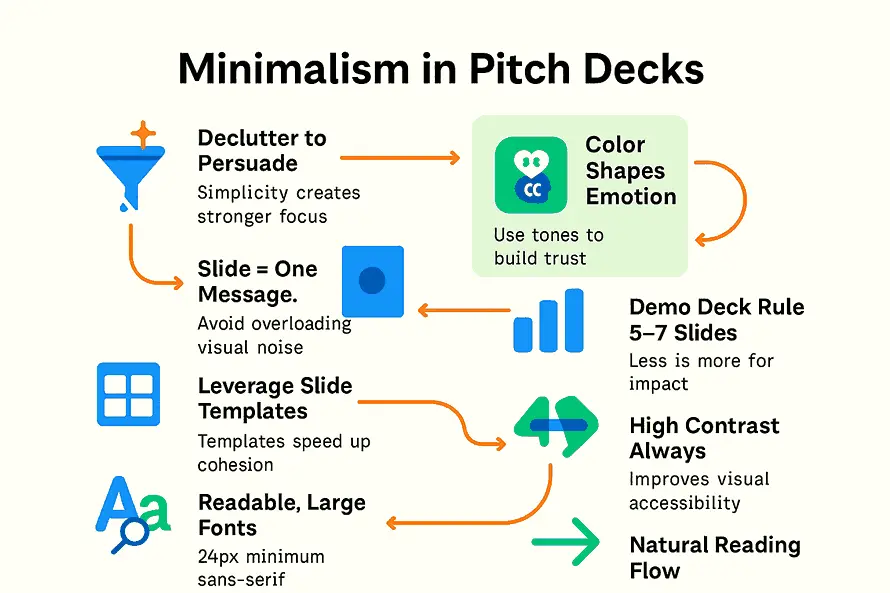
Minimalist Design Trend
The minimalist trend in pitch deck design revolves around cutting down visual clutter. By using consistent color palettes and white space strategically, you can direct attention to the core content instead of distracting elements. For example, employing bullet points instead of lengthy paragraphs simplifies information delivery while maintaining clarity.
A clean pitch deck cover sets the tone for a minimalist presentation. Additionally, leveraging pitch deck templates can aid in creating cohesive designs. These templates provide pre-designed layouts that align with branding while keeping the slides polished and professional. Integrating them into your deck ensures uniformity in style, making your presentation visually appealing and easy to follow.
Using Color Psychology for Investor Engagement
Building on minimalist design principles, color psychology plays a crucial role in shaping investor perceptions. Strategic use of color can evoke trust, optimism, or urgency, depending on your brand’s goals. For example, blue often signals reliability, while green suggests growth and innovation. Thoughtful color selection enhances clarity and strengthens brand alignment, making your pitch deck more memorable.
For high-impact presentations, Demo Day decks feature only 5-7 slides. This minimalist limit maintains core message focus and prevents overwhelming investors. Reducing clutter is proven to enhance deck impact.
Accessibility Principles for Clear Pitch Decks
- Use readable sans-serif fonts sized at least 24px to ensure text is legible from a distance.
- Apply high-contrast color schemes to make content visible for all viewers, including those with visual impairments.
- Organize slides with a natural left-to-right, top-to-bottom reading order for intuitive navigation.
Optimizing Pitch Deck Layout with Empirical Data
Applying pitch deck design principles ensures that data-driven decisions lead to more effective presentations.
Investors typically spend just 3 minutes and 44 seconds reviewing an entire pitch deck, with only 10 seconds allocated per slide. The data underscore the need for concise, visually engaging content that communicates key messages effectively.
Data Integration for Enhanced Engagement
Empirical data, which refers to information gathered from systematic observation or studies, offers valuable insights that can refine your pitch deck’s structure. Here are actionable ways to leverage these metrics:
- Focus on the Executive Summary: Investors often prioritize this section, making it essential to create a compelling overview. Concise messaging paired with impactful visuals ensures your core value proposition stands out. To learn more, explore the importance of a unique value proposition, where messaging and design work hand-in-hand.
- Limit Slide Content: Too much information overwhelms the reader. Utilize clear headings, bullet points, and strategically placed graphics to create slides that are easy to digest in under 10 seconds.
- Prioritize Visual Representation: Incorporate charts, infographics, and other visual aids to distill complex data into digestible content. Effective graphic design pitch deck elements not only improve readability but also enhance aesthetic appeal.
Pitch deck quality drives major funding outcomes. In early 2025, $145 billion was invested in seed-to-growth rounds by investors in the U.S. and Canada. This volume underlines why deck optimization directly impacts access to capital.
Customizing Pitch Decks for Audience and Stage
Building on empirical design strategies, tailoring your pitch deck to specific investors and funding stages can significantly boost engagement. Different audiences prioritize unique metrics and narratives. Knowing the difference between a pitch deck and an investor deck helps adjust depth accordingly. This approach increases the likelihood of securing interest and investment, making your presentation more effective.
Successful Pitch Deck Examples
Successful pitch deck design and slide deck strategies can be learned from leading startups. Companies like Airbnb, Dropbox, and Apple have set benchmarks in pitch deck design, showcasing how clarity and visual consistency can captivate investors. These examples demonstrate that a good pitch deck is not merely about aesthetics but about crafting a compelling narrative that communicates value.
Airbnb’s pitch deck is an excellent example of simplicity paired with precision. It clearly defines the problem, presents the solution, and highlights market potential, all within a concise and visually appealing framework. Airbnb’s clarity extended to its positioning against alternatives. Reviewing practical competition slide examples can sharpen differentiation.
Dropbox’s pitch deck, on the other hand, emphasizes storytelling. Through relatable scenarios and engaging visuals, it builds a narrative around the user experience. This approach underscores the importance of connecting emotionally with investors while presenting a scalable business model.
Apple’s pitch deck for the iPhone launch is a masterclass in leveraging brand identity. Its sleek design and focused messaging reflect Apple’s core values, proving that consistency in visual design can reinforce trust and credibility.
Creating impactful presentations is the cornerstone of successful pitch decks, ensuring that every slide captures investor attention.
Interactive Tools and Strategies for Real-Time Collaboration
Collaborative pitch deck design has transformed significantly with interactive tools and strategies that emphasize real-time teamwork. By utilizing advanced solutions, teams can streamline the creative process, ensuring that ideas are shared and refined efficiently.
For example, teams often use a cloud-based tool like Google Slides for seamless collaboration on pitch decks, allowing contributors to edit simultaneously and provide immediate feedback. This enhances the overall workflow and fosters a more dynamic design environment.
Many pitch deck design services offer professional collaboration platforms for creating creative pitch decks efficiently.
Key Strategies for Enhanced Collaboration
- Real-Time Input
Platforms equipped with live editing features enable team members to contribute directly to the pitch deck design. This real-time collaboration ensures that everyone’s input is integrated promptly, reducing delays caused by back-and-forth communication. - AI-Powered Design Tools
Utilizing the best pitch deck software equipped with AI capabilities can streamline layout creation. These tools suggest design adjustments and optimize visual elements, making the process more efficient for professional pitch deck design. - Continuous Feedback Loops
Iterative feedback mechanisms are crucial. Incorporating multimedia elements, such as embedded videos or infographics, allows teams to refine and elevate designs based on collective reviews.
Crafting a compelling pitch deck is just the beginning. At Qubit Capital, we provide comprehensive startup fundraising services to guide you through every stage of your fundraising journey.
Components of a Pitch Deck: Effective Slide Structuring
Creating a compelling pitch deck design and slide deck is often about finding the balance between clarity and persuasion. To achieve this, structuring slides effectively is key. Adopting a one-message-per-slide approach ensures that each slide communicates a single, focused idea.
This method prevents information overload and enhances audience retention. Coupling this with optimal text limits—keeping content concise and to the point—can make your presentation more digestible.
White space also plays a significant role in presentation deck design. It provides visual breathing room, helping to highlight essential elements without overwhelming viewers. By strategically using white space, presenters can guide the audience's attention to the most critical points.
Slide Structuring Tips
To craft a polished and impactful deck, follow these actionable steps:
- Use concise headlines: Headlines should immediately capture attention and summarize the slide's content.
- Limit text to essential points: Avoid lengthy paragraphs; instead, focus on bullet points or short sentences.
- Integrate visuals and charts to support the narrative: Graphs, images, and infographics can simplify complex data and make your message more engaging.
By prioritizing clarity and organization, you can create a pitch deck that resonates with your audience while delivering your key message effectively. For added convenience in your design process, explore free templates to streamline your workflow and access creative layouts.
Iterative Design and Feedback Mechanisms
Refining your pitch deck design is not a one-time process; it requires continuous evaluation and improvement. Iterative design, combined with A/B testing and feedback loops, offers a structured way to enhance your presentation's impact over time. This approach ensures your pitch evolves to meet investor expectations and effectively communicates your vision.
A/B Testing Best Practices
A/B testing is invaluable for testing variations in design and content. By comparing two versions of a slide, such as one focusing on data visualization and another emphasizing storytelling, you can determine which resonates better with investors. Focus on testing key slides such as your value proposition or revenue model. A clear business model slide format makes experiments measurable.
To simplify the process, startups can utilize design software like Visme for crafting visually rich and interactive slides. This tool allows you to experiment efficiently with colors, layouts, and typography, enabling you to test and refine your pitch deck in real-time.
Collecting Investor Feedback
Feedback is the backbone of iterative improvement. Engage with investors and peers to gather insights on your pitch's clarity and effectiveness. Pay attention to recurring themes or suggestions, as they often highlight areas needing improvement. Use measurable metrics, such as engagement levels during presentations, to pinpoint what works and what doesn’t.
When refining your deck, focus on creating a professional pitch deck design that balances compelling visuals with clear messaging. Whether through surveys or direct conversations, feedback ensures your deck evolves into a modern pitch deck design that leaves a lasting impression.
Conclusion
Pitch deck design is the bridge between your vision and an investor’s interest. Implementing pitch deck design principles is key to crafting a compelling narrative that resonates with investors.
We invite you to enhance your pitch deck design with our expert Pitch Deck Creation service. Contact us to create a compelling presentation that resonates with investors and drives your startup toward success.
Key Takeaways
- Effective pitch deck design relies on clear visual storytelling and minimalism.
- Empirical metrics like 10 seconds per slide and a 3 minute 44 second review time drive design best practices.
- Interactive tools and AI-powered platforms enhance slide layout and overall engagement.
- Case studies from successful startups provide actionable design strategies.
- Iterative feedback and A/B testing are essential for continuous improvement.
Need a pitch deck investors actually read?
A deck built to answer real investor questions. Clear story, strong positioning, investment-ready slides.
- Structure your narrative and core messaging
- Fix clarity gaps and investor objections
- Investor-grade design and structure
Frequently asked Questions
What makes a professional pitch deck stand out?
A professional pitch deck stands out with clear storytelling, minimalistic design, strong data visuals, and seamless branding. Interactive elements engage investors and boost impact.